
Building services
Commercial Roofing and HVAC Prospecting
We screen every commercial building in the territory you name for membrane type, ponding, rooftop unit count, last permitted reroof, and storm history. The first 3 are free.
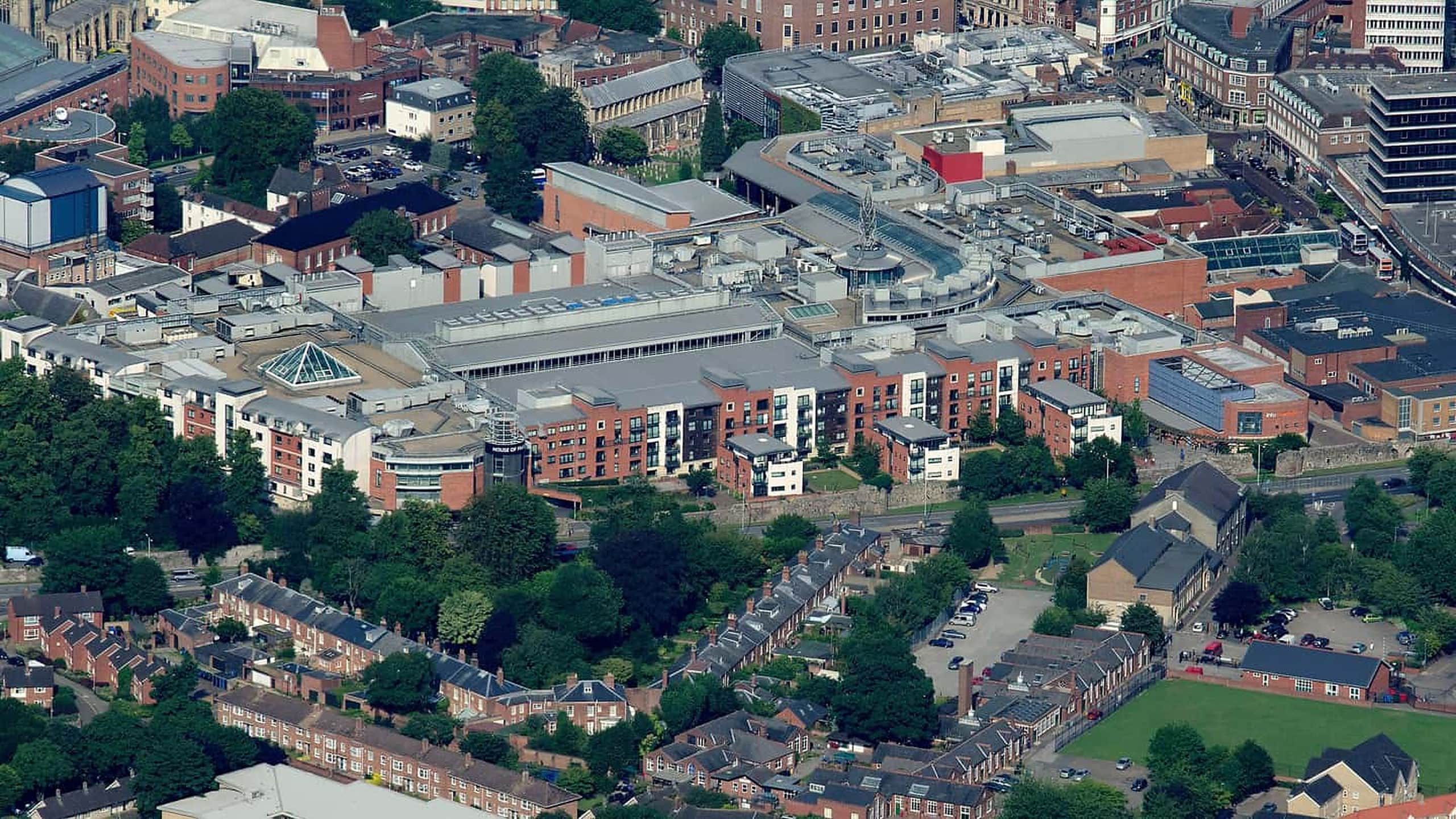
Free preview: 3 properties, delivered 3 business days after we confirm your territory. No card, no call.Photo: John Fielding (CC BY 2.0)
A single-ply roof has a 20-year life and a permit trail. Every building in your territory is somewhere in that cycle; the permit trail says where.
Contractors chase storms and buy the same hail list everyone else bought that week, while a 2004 TPO deck with ponding around a blocked drain sits unremarked. We look at all of them.
See how the research worksEvidence
The eight things a commercial building tells an estimator before anyone climbs a ladder
These observations decide whether a building enters the pipeline, which trade it belongs to, and roughly how big the scope is.
| Indicator | Where it comes from | What it settles — and what it does not |
|---|---|---|
| Roof system type | Where it comes fromImagery, oblique views where flown, assessor roof-cover and construction fields | What it settles — and what it does notSeparates white single-ply, black EPDM, gravel BUR, modified bitumen, and standing-seam metal, which decides which crew the building belongs to. Insulation type, thickness, and R-value are not visible. |
| Ponding and drainage failure | Where it comes fromPost-rainfall imagery showing standing-water rings, visible drain and scupper placement | What it settles — and what it does notIdentifies decks with slope failure or blocked drainage, a strong roofing signal that imagery can show. It does not establish deck saturation or wet insulation; that is an infrared scan and a core cut. |
| Last permitted roof work | Where it comes fromMunicipal and county permit indexes for reroof, recover, and repair scopes, with valuation | What it settles — and what it does notGives the date and rough size of the last recorded roof event, direct age evidence against a 15–25-year single-ply life. Unpermitted work and coatings leave no trace. |
| Rooftop unit count and footprint | Where it comes fromImagery footprints of packaged units and condensers, mechanical permit records | What it settles — and what it does notCounts units and estimates tonnage from curb footprint, which sizes a replacement or maintenance-agreement conversation. Model, refrigerant, actual age, and condition are on the data plate. |
| Severe-weather exposure | Where it comes fromNOAA severe weather reports and gridded hail swaths, with dates and estimated stone size | What it settles — and what it does notEstablishes that this parcel recorded a 1-inch-or-larger hail day, or a damaging wind event, on a specific date. It does not prove damage, an open claim, or coverage. |
| Pavement and exterior condition | Where it comes fromImagery of the parking field and drive aisles | What it settles — and what it does notShows alligator cracking, patch outlines, rutting at loading areas, and faded striping well enough to size a paving or sealcoat scope. Subgrade and base thickness are not visible. |
| Building age and use | Where it comes fromAssessor year built, use code, gross building area, number of stories | What it settles — and what it does notPlaces the building in its service cycle and flags use types with known maintenance profiles — cold storage, food service, big-box retail. Renovations that reset the cycle may not be recorded. |
| Ownership and management path | Where it comes fromAssessor owner of record, mailing address, entity name patterns, business listings on site | What it settles — and what it does notDistinguishes an owner-occupied building with the decision-maker on site from an institutionally held asset managed at a distance. The approver's name is not in the public record. |
Permit indexing is the least consistent source here — some counties publish twenty years, some publish nothing. Where the trail is missing, the report says so on that property rather than inferring.
This finds the buildings worth inspecting. It never claims to be the inspection.
Everything in the second list needs someone on the roof, a data plate, or a document.
Settled by the report
- Which roof system each building carries, and which of your crews it belongs to
- Which decks show ponding or drainage failure in current imagery
- When the roof was last permitted, where the jurisdiction indexes permits
- How many rooftop units a building carries and roughly how large they are
- Which dated hail and wind events the parcel has recorded
Not settled — inspection or records required
- Whether the roof is leaking, and whether the insulation below is wet
- Remaining useful life, warranty status, or whether a replacement is budgeted
- Rooftop unit model, refrigerant, age, or mechanical condition
- Whether a storm caused compensable damage, or whether a claim exists
- Code compliance, structural condition, or hidden defects
The five checks between a ranked building and a signed scope
- Walk the roof and core the deck before quoting a replacement, and scan where ponding was flagged.
- Read the data plates: make, model, manufacture date, and refrigerant decide service versus replacement.
- Ask the owner for the roof warranty, the last reroof invoice, and any existing service agreement.
- Confirm the decision path — owner, asset manager, or property manager — and the capital-approval cycle.
- Where storm exposure drove the rank, let the adjuster or engineer establish causation.
What arrives, piece by piece.
Every ranked building carries the observation that put it there, so canvasser and estimator work from the same evidence.
- 01Set the trade profile and geographyYou define the service lines, minimum building size, the storm window, and the counties to cover.
- 02Screen every commercial parcelWe review imagery, assessor records, permit indexes, and weather history building by building, not by sample.
- 03Rank and mark the confidenceAn analyst orders buildings against your trade profile and flags where a source was missing or stale.
- Ranked building register
- Every qualifying property, ordered, with address, parcel identifier, and the observation driving the rank.
- Roof system and drainage notes
- Apparent membrane or metal system, roof geometry, drain and scupper placement, and any visible ponding.
- Mechanical inventory
- Rooftop unit count with approximate curb footprints, plus any mechanical permits located for that address.
- Permit and age trail
- Year built, gross area, use code, and the reroof, recover, and mechanical permits found, with dates.
- Storm history for the parcel
- Dated severe-weather events at that location, with estimated hail size or wind speed, in the window you set.
- Exterior and pavement observations
- Parking field condition, striping state, loading-area rutting, and any visible curb or vegetation scope.
Further reading
How this screen is actually run.
What a storm record proves, who this fits, and how far it goes.
No. It establishes roof system, visible ponding, permit age, unit count, and storm history; whether work is needed is decided by a roof walk, a core cut, an infrared scan, or a data plate.
Commercial roofing, building envelope, HVAC, paving, exterior maintenance, and multi-trade facility contractors. Indicator weighting follows the trade — roofing ranks ponding and permit age first; HVAC ranks unit count and use type.
No — storm history is one of eight indicators and the weakest one alone, because every contractor has the same swath data. The value is a dated hail event on a parcel that also shows an old membrane and ponding.
Yes. Territory Monitor keeps up to 500 properties under watch and puts 100 through analyst review each month, from $1,500 a month on an initial 2-month term.
Other property questions we answer with the same workflow.
Property risk and resilience screening
The same roof and storm evidence, turned around for owners ranking a portfolio.
Read the report typeCommercial solar prospecting
When the roof is a platform rather than a product: usable membrane and tariff regime.
Read the report typeCustom territory and market analysis
A property question that does not fit a standard trade screen, scoped the same way.
Read the report type
Send us your trade and your territory, and we will rank 3 buildings in it.
Name the service lines, the minimum building size, and the geography. We return 3 ranked buildings with roof, mechanical, permit, and storm evidence in 3 business days, free.
3 properties · 3 business days · no card