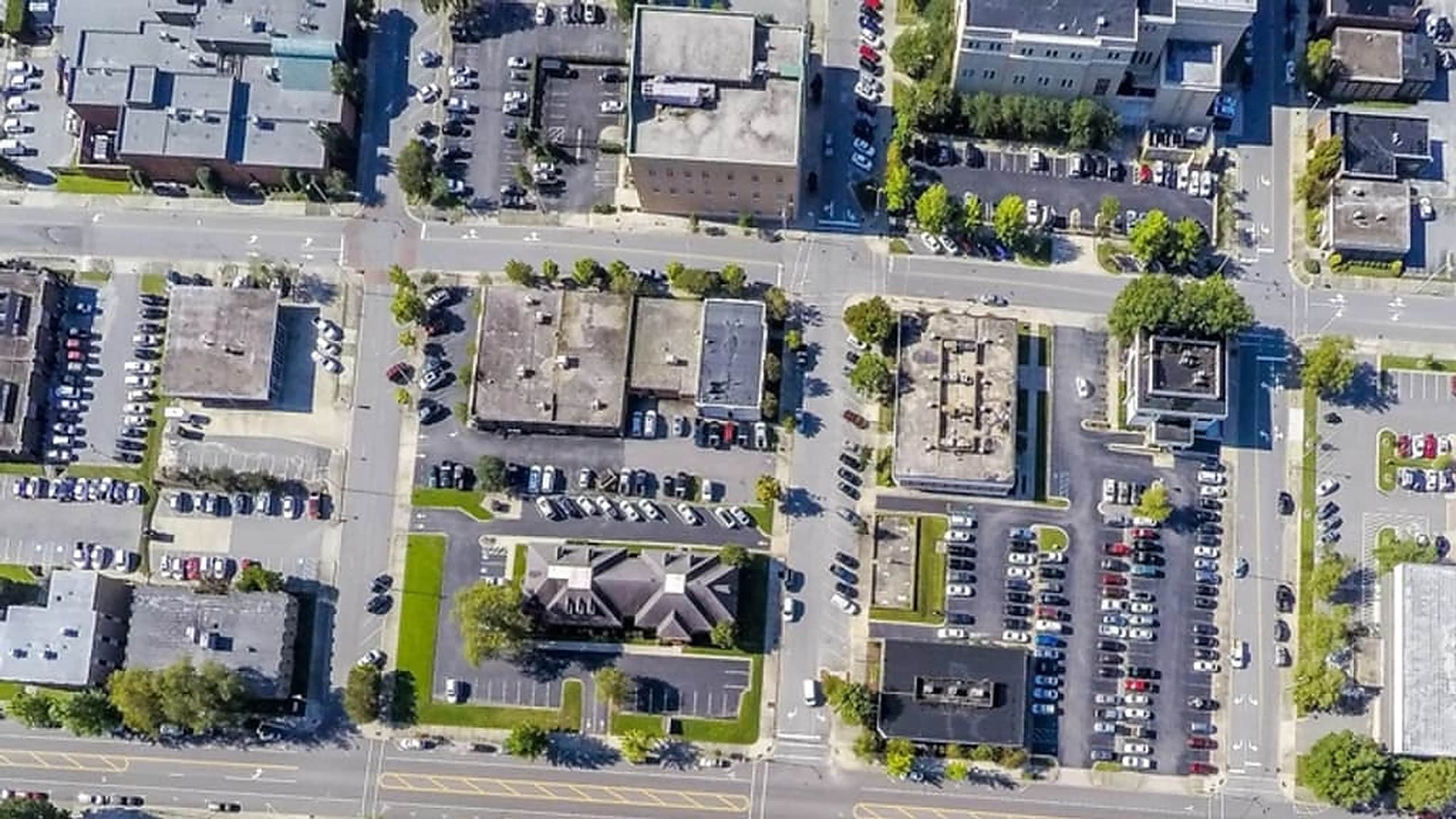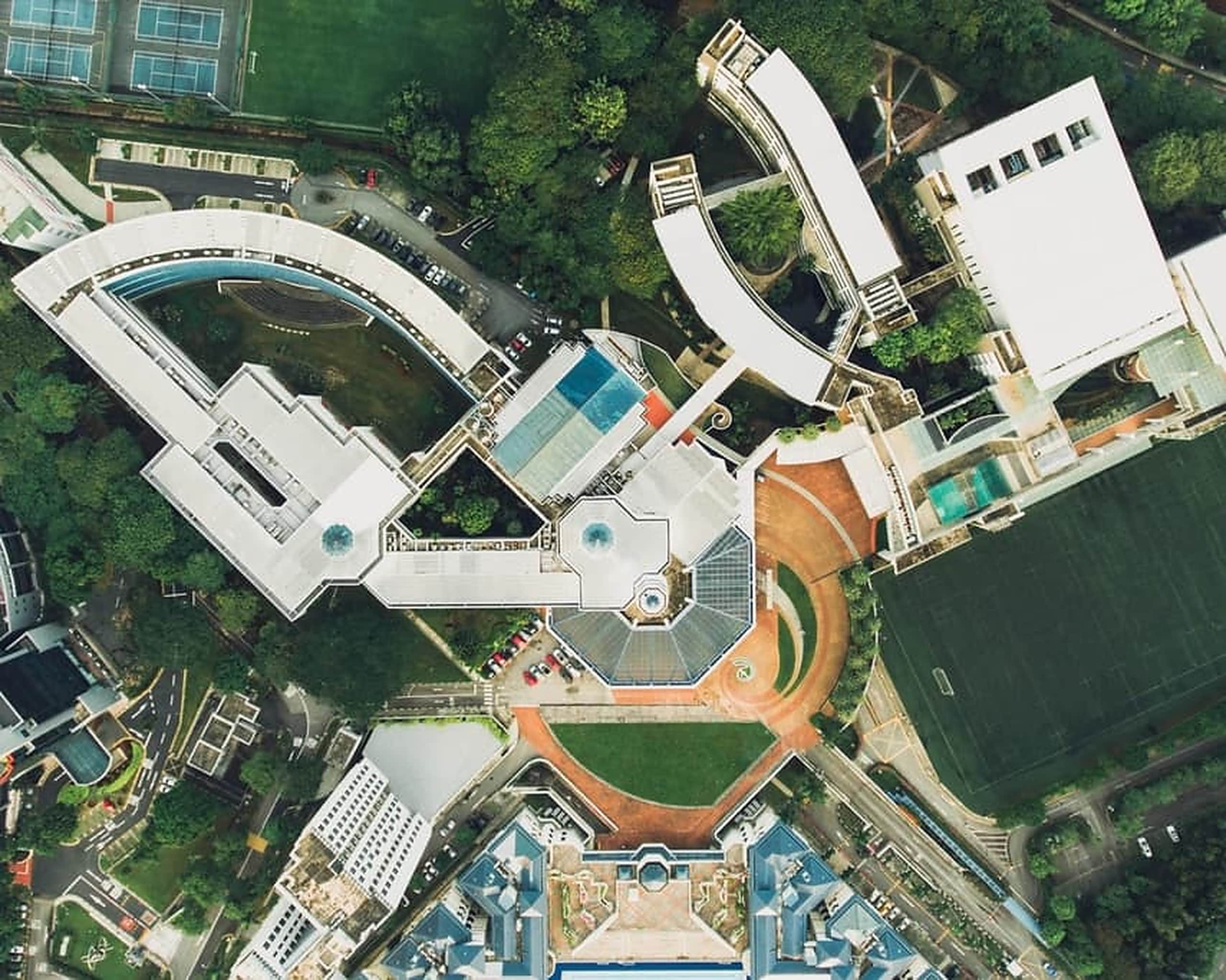
Aerial imagery is good at one narrow thing: telling you which roofs in a territory look worse than their neighbors. That is genuinely useful when you are deciding where to send an inspector. It becomes a liability the moment it is written up as a condition report.
The distinction is not about resolution. It is about what a top-down photograph can physically contain. Below is where the line sits.
What reads reliably from overhead
These features have a visual signature that survives compression, atmospheric haze, and a typical public imagery resolution. They are observations, and they should be cited to the image and the date that carried them.
- Ponding. Standing water on a low-slope roof reads as a dark, smooth-edged area, usually near a drain or a deflected span. It is most legible in a capture flown shortly after rain.
- Patch and repair scarring. Repairs rarely match. A field of mismatched rectangles, a darker seam run, or a bright new section against a weathered field all indicate work has been done.
- Staining and biological growth. Algae streaking on shingle, moss on north-facing planes, and dark organic staining around a drain or a mechanical unit all read clearly.
- Gravel displacement on a ballasted roof. Scoured strips, exposed dark membrane, and gravel piled at a parapet are visible and suggest wind scour or foot traffic.
- Obvious membrane seam failure. A lifted, wrinkled, or open seam on a large single-ply roof can be visible when it is severe enough to cast a shadow line.
- Debris and blocked drains. Branches, sediment fans, packed material at a scupper, and a ring of standing water around a drain all read.
- Equipment added since the last capture. Comparing two vintages of imagery shows new units, new penetrations, new screens, and new arrays.
On residential stock the same list applies with different weights. Streaking, moss on the shaded plane, missing or lifted shingle tabs on a steep plane, tarps, and a visibly re-roofed section all read. What you are looking for is inconsistency across a surface that should be uniform.
What does not read at all
Everything under the top surface is invisible. This is not a limitation of a particular imagery program. It is a limitation of photography.
- Substrate and deck condition. Rot, delamination, and deflection short of visible ponding are not observable.
- Insulation saturation. A wet insulation layer under an intact membrane looks exactly like a dry one from above. Finding it is what infrared and moisture scans are for.
- Fastener state. Backed-out fasteners, failed plates, and inadequate attachment density are not visible.
- Deck corrosion, particularly on a metal deck under a membrane assembly.
- Remaining membrane life. Weathering appearance and remaining service life are not the same variable, and one does not give you the other.
- Warranty status, installation quality, and whether the last repair was done by someone competent.
A roof can look poor from above and be structurally sound. It can look clean from above and be saturated underneath. Both cases are common enough that neither direction of inference is safe.
The part that is easy to get wrong: imagery vintage
It is a large source of error in remote condition work, and it has nothing to do with interpretation skill.
Public aerial imagery over a given county is commonly one to three years old. National imagery programs fly on a multi-year rotation, state by state, and county-commissioned flights follow their own schedules. The image you are looking at is a photograph of a specific day, and that day may be two summers ago.
A roof can be replaced the week after the plane flew. Ponding visible in a 2023 image tells you a drainage problem existed in 2023, which is a reason to look, not a finding about today.
- Put the capture date next to every observation, in the report, not in a footnote.
- Where two vintages are available, compare them. Change between captures is often more informative than either image alone.
- Treat an observation older than the local permit record as provisional, and check the permit index for roofing work filed since the capture.
- When a property is ranked partly on a stale image, mark the rank as resting on a stale source.
Capture season changes what is legible
Season is the second half of the vintage problem. National programs generally fly leaf-on and close to midday, which is good for even illumination and bad for several things you might want to see.
- A midday summer capture has short shadows, which flattens relief and hides seam lift, parapet damage, and deflection.
- Leaf-on canopy hides roof sections entirely on tree-lined residential streets. An unobserved section is not a clean section.
- A dry-season capture will not show ponding, because there is no water on the roof to show.
- Snow cover removes the roof from the analysis completely, and a partial melt pattern is about insulation and sun angle rather than condition.
- Low winter sun exaggerates minor surface irregularity into apparent damage.
How to write the observation up
The format does most of the honesty work. A well-written condition note is hard to over-read, and a badly written one invites a rep to say something on a call that nobody can support.
- State the observation, not the conclusion. "Dark pooled area at the northwest drain" rather than "drainage failure."
- Name the source and the capture date, every time.
- Say what the observation cannot establish, in the same note.
- Name the next check that would resolve it: a permit search, an infrared scan, a core sample, a site visit.
- Where the roof is partly obscured by canopy or shadow, record the obscured extent instead of ranking as though the whole surface were seen.
What this buys a territory
Used this way, aerial condition reading changes the order of a route rather than the content of a proposal. It moves the roofs showing patch scarring, standing water, and blocked drains toward the front of the queue, and it moves clean, recently re-roofed buildings toward the back.
That reordering is worth real money in field time. Claiming more than that is what turns a useful screen into a claim the first inspection contradicts.