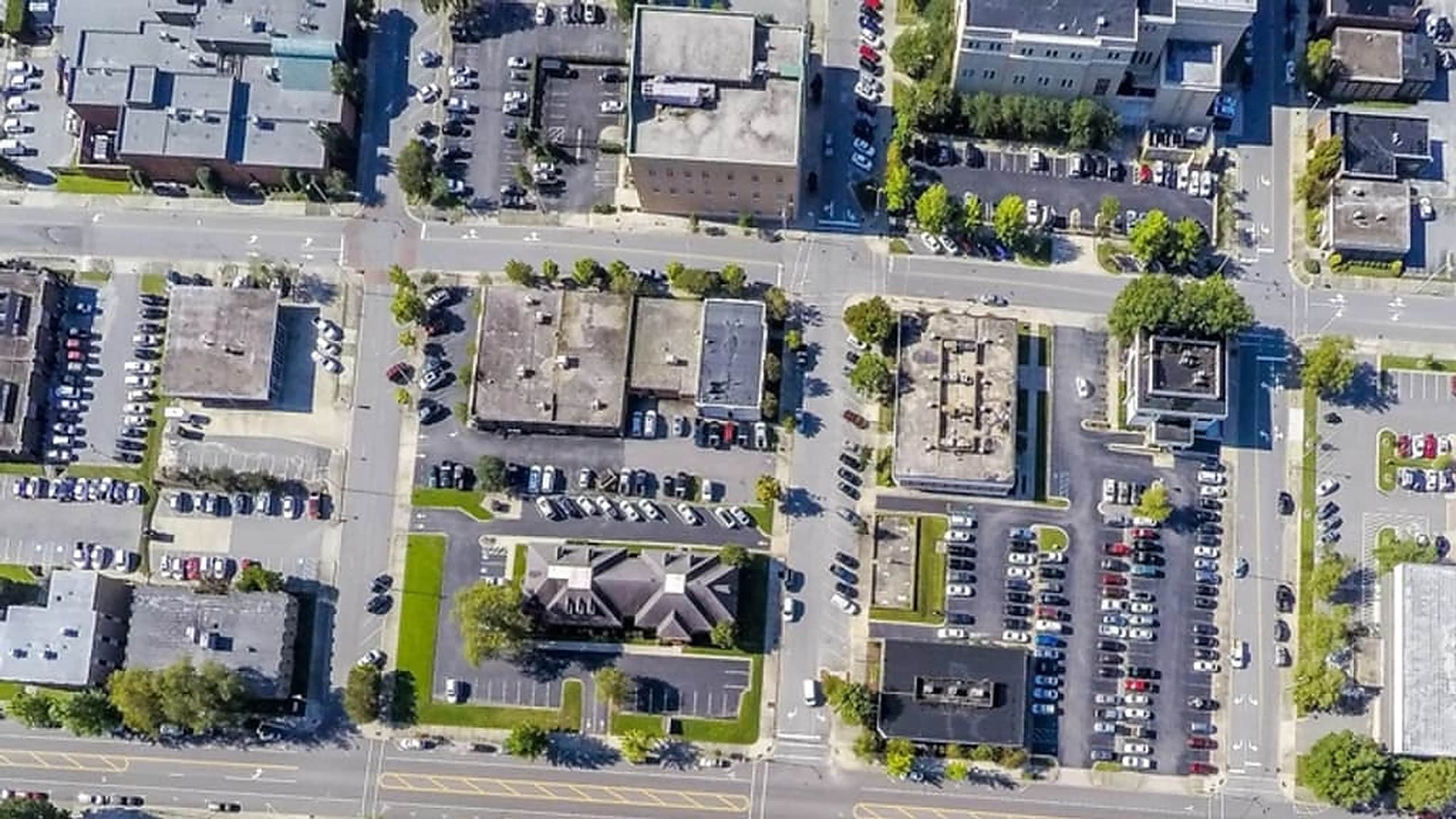
Commercial roofing sales runs on a familiar loop. A storm comes through, every contractor in the metro canvasses the same industrial parks, and the owners who picked up the phone last spring stop picking up.
The contractors who do well outside that loop know which roofs need attention before anyone knocks, and most of what they know is public. Here is how to rank a territory's commercial roofs from above, and where the public record runs out.
1. Read the roof system first
Imagery, oblique views where they have been flown, and the assessor's roof-cover and construction fields together indicate the roof system on many commercial buildings: single-ply membrane, modified bitumen, built-up, standing-seam metal, or something older. Where they are silent or disagree, record the system as unknown.
System type decides which of your crews the building is for, and roughly where it sits in its service life. A contractor who does not install coatings has no reason to rank a building whose best next step is a coating.
2. Find the last permitted roof work
Municipal and county permit indexes record reroof, recover, and repair scopes, often with a date and a valuation. The date of the last permitted roof work is one of the clearest public signals that a replacement conversation is near.
Read the absence carefully. A building with no roof permit in twenty years may be overdue — or its owner may have had work done without a permit, or the jurisdiction may not index permits that far back.
3. Look for water that stays
Imagery flown after rain sometimes catches standing water: the rings and staining of ponding on a flat roof, drains in the wrong place, scuppers that do not match the slope. Ponding shortens membrane life, and it is one of the most visible failure signals from above.
It depends entirely on when the flight happened. A dry-day image shows none of it, so the absence of ponding in one image is not evidence of good drainage.
4. Add the storm record, with dates
NOAA severe weather reports and gridded hail swaths put a date and an estimated stone size on a location. A building under a swath of large hail in the past two seasons, with no roof permit since, is worth a closer look.
The record says a storm crossed the address. It does not say the roof was damaged, and it does not say a claim is open. Lead with the date and the observation, never with a promise about insurance — commercial property hail damage screening covers how far the storm record goes.
5. Count the rooftop units
Packaged units and condensers are visible from above, and mechanical permits sometimes record when they were replaced. Unit count matters to a roofer because every curb is a penetration to flash, and it matters to an HVAC contractor in its own right.
For a contractor who does both, a building with an aging roof and a dense field of old units is two conversations with one owner.
6. Work out who decides
The assessor record gives an owner of record and a mailing address. Entity names, an out-of-state mailing address, and the businesses listed on site together separate an owner-occupied building from an investment property run by a manager.
- Owner-occupied industrial and retail: the decision often sits with a facilities or operations lead on site.
- Multi-tenant and investment property: the property manager usually starts the conversation, and ownership approves the spend.
- Portfolio owners: one decision can cover many roofs, which changes how the first call should be framed.
None of this names the person or confirms who holds the budget. It tells you which kind of conversation to prepare for.
Rank the territory, then work the list
Put the signals together — system and age, last permitted work, ponding, storm exposure, unit density, and the ownership path — and rank the buildings with the weighting written down in advance. The top of that list is where an estimator's week should go.
That is the screen our commercial roofing and HVAC reports run, with the evidence and the open checks attached to every building. For how the same imagery reads a roof's condition, see roof condition assessment from aerial imagery.
What imagery and records cannot tell you
- The condition of the membrane, the insulation, or the deck. Only an inspection establishes that.
- Whether a warranty is active, or which contractor holds it.
- Whether storm damage occurred, or whether a claim exists.
- Whether the owner has budget, or is already talking to someone else.
The screen finds the roofs worth a site visit. It never claims to be the site visit.