
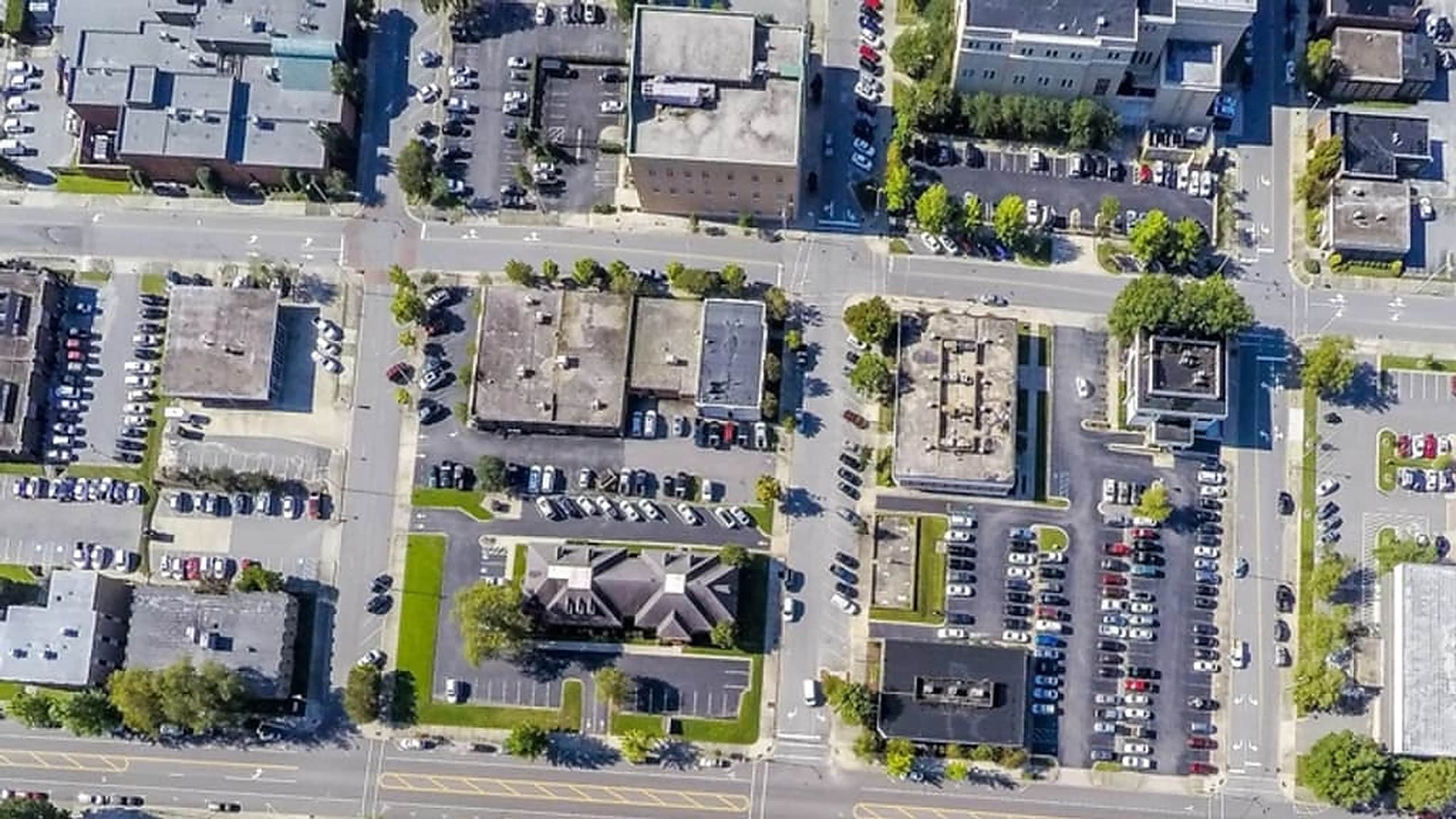
A lot of commercial solar prospecting still starts from the windshield. A rep drives a corridor, sees a wide flat roof, writes down the address. That works until the territory is larger than a day of driving.
The alternative is a screen you can run the same way twice. It is not glamorous. It is four sources read in order, with a written note at each step about what that source did and did not settle.
1. Fix the radius and the size floor first
Two numbers govern everything downstream. The first is the service radius, measured in drive time from the yard rather than in straight-line miles. The second is the smallest roof worth a truck roll.
That second number is yours, not ours. Work it back from the smallest job your crew has actually mobilized for profitably and use that as the floor. If you have never written it down, the screen will drift toward whatever roof looks biggest.
- Service radius, expressed as drive time from each yard or crew base.
- Minimum usable roof area, or minimum array size, below which you will not mobilize.
- Roof assemblies your crews are set up to attach to, and the ones you decline.
- Property types you have installed on before, which is a different list from the ones you would consider.
- Explicit exclusions: leased-roof retail, tenant-occupied multi-parcel campuses, anything under a known moratorium.
2. Narrow the parcel list before you open imagery
The county assessor publishes a parcel layer with a land-use or property-class code on every record. Filtering that layer to commercial, industrial, and institutional codes inside your radius produces the candidate pool. It is a coarse filter and it is meant to be.
Land-use codes are assigned for assessment, not for solar. A code will not tell you whether the building is occupied, whether the roof was replaced last year, or whether the parcel holds one building or nine. Treat the result as a pool to screen, not a list to call.
3. Read the roof from imagery
USDA NAIP orthoimagery is public and covers the lower 48 states on a rolling two-to-three-year cycle by state. It is enough to judge the shape of the opportunity. Four things are worth recording per roof.
- Usable area: the footprint minus setbacks, minus the walkway and access paths you would have to keep clear.
- Obstruction load: HVAC curbs, exhaust fans, skylights, ducting runs, screen walls, parapet-mounted equipment, and how much of the field they fragment.
- Orientation and roof geometry: single-slope, multi-section, sawtooth, or genuinely flat, and which way the long axis runs.
- Shading context: adjacent taller structures, tree lines on the south side, and the direction the shadows fall in the frame you are looking at.
Note the capture date beside every observation. NAIP is flown leaf-on and near midday, so shadows are at their shortest of the year. An evergreen or a neighboring building that clears the roof in a July frame may not clear it in February, and a building put up since the flight is simply absent.
Imagery also cannot see through the roof. Structural capacity of the deck, the age and remaining life of the membrane beneath ballast or gravel, the size of the electrical service, and where the point of interconnection sits are all invisible from above. Those are engineering questions and they stay open until an engineer answers them.
4. Cross-check the parcel and assessor record
Once a roof looks worth the effort, go back to the assessor record for the same parcel and read it properly rather than glancing at the owner name. The sources a screen reads, and what each one settles, are worth knowing before you trust any single field.
- Year built, as a first proxy for the age of the structure and often for the roof assembly beneath it.
- Roof cover and construction fields, where your county populates them. Many do not, and a blank field is a blank, not a negative.
- Recorded building area against the footprint you measured in imagery. A large gap usually means multiple stories, an addition, or a mismatched parcel.
- Owner of record, and whether the owner mailing address matches the site address. When they match, the occupant is more likely to be the decision maker; when they differ, expect a landlord.
- Last sale date. A transfer inside the last year or two often means the assessor record is still showing the previous owner.
Owner-occupancy is the field that changes the most about how you would approach the property, and it is also the easiest to skip. A matching mailing address does not prove occupancy, and a mismatch does not prove a lease. It tells you which question to ask first.
5. Search the permit index for arrays already installed
The last screen is the easiest one to skip and the most expensive to skip. Search the county or municipal permit portal against the address for electrical and photovoltaic permits — three years back is a reasonable window for recent work, and the whole installed base in your market needs the full history.
Search the text, not just the permit type. Jurisdictions file the same work as "PV," "photovoltaic," "solar," "solar PV," or under a generic electrical class with the detail buried in the description. While you are in the index, pull roofing permits too. A membrane replaced recently is a genuinely different conversation from one at the end of its life.
6. Rank the survivors, and write down why
What comes out of four screens is an ordered list, and the order is only useful if it is legible. Each row should carry the reasons it ranked where it did, the source and capture date behind each reason, and the specific checks still open on that property.
Resist a precise-looking composite number. Bands work better. A property in the top band means "open this one first," and the reasons underneath should tell a rep what to say in the first thirty seconds without overstating anything.
The honest limit sits at the end of the whole method: nothing in imagery, a parcel file, or a permit index establishes owner intent. You can establish that a roof is large, unobstructed, well oriented, apparently owner-occupied, and unpermitted for PV, and the owner can still have no interest, no capital, and no intention of answering the phone. The screen decides where you spend the week. The conversation decides everything after that.